
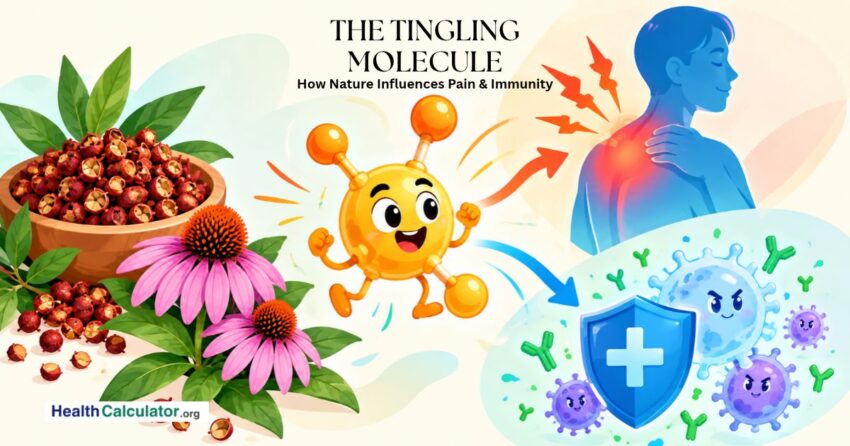
Alkylamides are a family of plant compounds that interact with your nervous system and immune system. The sanshools in Sichuan pepper create a tingling vibration by activating touch fibers in your mouth. The alkylamides in Echinacea bind to cannabinoid receptors on immune cells and modulate inflammation. The science is early but the mechanisms are real and measurable.
I still remember the first time I tried mapo tofu at a small Sichuan restaurant. The numbing tingle started on my lips. Then it spread across my tongue and into my gums. It was not a burn like chili. It was a vibration, a faint buzz that seemed to come from nowhere and everywhere at once.
That sensation has a name in Chinese cooking. It is called ma. And it comes from a family of compounds called alkylamides.
Most people have never heard the word alkylamide. But you have felt its effects. You have felt it in Sichuan pepper. You may have felt it in the toothache plant. And if you have ever taken Echinacea for a cold, you have consumed alkylamides without knowing it.
These compounds do something unusual. They let you feel their mechanism of action.
The tingle of Sichuan pepper is not a flavor. It is a touch signal. The immune effects of Echinacea are not a vague boost. They are a specific interaction with receptors on your immune cells.
This article explains what alkylamides are, how they work, and what the research actually shows. No hype. No miracle claims. Just the science behind the sensation.
What Are Alkylamides
Alkylamides are a group of organic compounds found in certain plants. The term covers a wide family of molecules. A small change in chemical structure can change how a compound behaves.
The core structure is an amide group. That is a carbonyl bonded to a nitrogen. In many plant alkylamides, this group links a fatty acid chain to an amine.
The chain can be short or long. It can contain double or triple bonds. Many plant alkylamides are lipophilic. That means they are drawn to fats and oils. This affects how they cross cell membranes and how they are extracted in supplements.
Alkylamides are not one chemical. They are a family. Each member has its own properties. That is why two Echinacea products can behave differently. That is why Sichuan pepper tingles in a specific way.
The Tingling Science of Sichuan Pepper
Sichuan pepper is not a pepper in the botanical sense. It is the dried husk of a shrub in the Zanthoxylum genus. Its ma sensation comes from alkylamides called sanshools.
The main compound is hydroxy alpha sanshool. This molecule activates specific sensory neurons in your mouth. It does not target the same receptors as chili. Chili activates TRPV1, the capsaicin receptor. Sanshool targets a different set of fibers.
Research has shown that sanshool activates RA1 fibers. These are rapidly adapting mechanoreceptors. They respond to light touch and vibration. They are part of your somatosensory system, the network that detects physical sensations on your skin and in your mouth.
A study published in the journal Food Quality and Preference asked participants to match the tingle of Sichuan pepper to a mechanical vibration on their fingertip. The perceived frequency was consistently around 50 hertz. That is roughly 50 taps per second. The same frequency range that RA1 fibers respond to best.
So the tingle is not a chemical burn. It is a vibration signal. Your brain interprets it as touch because that is the channel the signal travels through.
This discovery was surprising because it showed that a chemical compound could create a purely tactile sensation. Sanshool is not activating taste buds. It is hijacking touch fibers.
The structure of the sanshool molecule determines the quality of the sensation. Hydroxylation increases intensity. Longer alkyl chains prolong the duration. The stereochemistry of the double bonds determines whether you feel tingling or numbing.
This is structure activity relationship in action. A small change in the molecule produces a noticeable change in the sensation you feel.
From Tingling to Pain Relief
The same mechanism that makes Sichuan pepper tingle may have therapeutic potential.
The toothache plant, Acmella oleracea, contains an alkylamide called spilanthol. Spilanthol produces a strong buzzing sensation when chewed. Traditional medicine has used the plant for oral pain for centuries.
A 2025 study in the journal Nutrients investigated Acmella oleracea extracts for neuroprotective potential against chemotherapy induced neuropathic pain. Neuropathic pain is a major side effect of certain cancer drugs. It causes tingling, numbness, and shooting pain in the hands and feet.
The researchers found that extracts from both the aerial parts and the roots of the plant significantly alleviated neuropathic pain in mice. The extracts also enhanced SOD activity, an antioxidant enzyme, and reduced cytotoxicity in neuronal cells.
The study noted that the effects were not solely related to spilanthol. Phenolic compounds in the plant also contributed. But the alkylamides played a central role.
This is early stage research. It does not mean that eating toothache plant will cure nerve pain. But it does show that alkylamides interact with pain pathways in ways that scientists are still working to understand.
Spilanthol appears to modulate TRP channels, particularly TRPV1, which is central to pain signaling. TRPV1 is the same channel that chili activates. But spilanthol activates it differently. It produces a buzzing sensation rather than a burning one.
This is a recurring theme with alkylamides. They interact with systems that are already involved in pain and sensation. But they do so in ways that are subtly different from other compounds.
The Immune Connection in Echinacea
Sichuan pepper and toothache plant are not the only sources of alkylamides. Echinacea, the purple coneflower, is another major source. And its alkylamides do something different.
Echinacea alkylamides interact with the endocannabinoid system. This is the same system that responds to compounds in cannabis. But the interaction is not about getting high. It is about immune regulation.
Research has shown that Echinacea alkylamides bind to the cannabinoid receptor type 2, or CB2. These receptors are found mainly on immune cells, such as macrophages and lymphocytes. They are not the same as CB1 receptors, which are concentrated in the brain.
A 2026 review in the journal Phytomedicine Plus described how Echinacea alkylamides demonstrate multi target behavior. They activate CB2 at nanomolar affinity, which dampens TNF alpha and IL 6. These are key inflammatory cytokines. They also partially antagonize TLR4, a receptor that triggers immune responses, which helps re balance Th1 and Th2 cytokine bias.
This is not a simple immune boost. It is immune modulation. The compounds dial down inflammatory overreaction while keeping immune surveillance intact.
The structural basis for this activity is interesting. Alkylamides are structurally similar to anandamide. Anandamide is an endogenous cannabinoid, a molecule your body makes naturally. It is sometimes called the bliss molecule because it binds to cannabinoid receptors and influences mood and pain perception.
Echinacea alkylamides share structural similarities with anandamide. Both have a fatty acid chain linked to an amide group. This similarity allows alkylamides to bind to CB2 receptors and modulate immune function in ways that are similar to the body’s own signaling molecules.
A specific alkylamide called dodeca 2E,4E dienoic acid isobutylamide has shown potent antiviral activity against rhinovirus, the cause of most common colds. It also inhibits IL 8 production. IL 8 is a cytokine responsible for many cold symptoms.
This is laboratory research. It does not prove that Echinacea supplements prevent or cure colds. But it does explain why the plant has been studied for respiratory infections for so long. If you want to explore other evidence based approaches to immune health, our guide on 10 ways to boost your immune system naturally covers practical steps backed by research.
What This Means for Supplements
The gap between laboratory research and clinical evidence is large. This is especially true for herbal supplements.
The National Center for Complementary and Integrative Health has reviewed the evidence on Echinacea. Their conclusion is cautious. Taking Echinacea may slightly reduce your chances of catching a cold. It is still unclear whether it can shorten the length of a cold.
A comprehensive 2014 assessment concluded that Echinacea has not been convincingly shown to be beneficial. Some studies show a small effect. Others show none.
The variation in results is partly explained by product variability. Two Echinacea products can contain very different amounts of alkylamides. The species matters. The plant part matters. The extraction method matters. The soil and bacteria in the plant can even affect the herb’s immune effects.
This is not a reason to dismiss Echinacea. It is a reason to be careful about what you buy. This pattern is common with plant compounds. For another example, our article on oil of wild oregano benefits and uses examines what the research shows and where the evidence is still lacking.
Some experts recommend standardized extracts containing around 4 percent alkylamides. These provide more consistent bioavailability across preparations. If you choose to use Echinacea, look for products that specify the alkylamide content.
A related class of compounds called ALIAmides has shown strong safety in pediatric populations. ALIAmides include palmitoylethanolamide, or PEA, and Adelmidrol. A 2026 review in Frontiers in Pharmacology found that these compounds have favorable safety and tolerability profiles in children. Oral PEA reduced the need for rescue medications in children with migraine and irritable bowel syndrome. Topical PEA allowed discontinuation of corticosteroid creams in most treated children.
PEA is not the same as the plant alkylamides in Echinacea. It is an endogenous fatty acid amide. But it belongs to the same broad family of signaling molecules. Its safety profile is reassuring for anyone interested in this class of compounds.
A Note on Safety
Alkylamides from food sources like Sichuan pepper are generally safe. The amounts consumed in cooking are small. The tingling sensation is temporary and benign.
Echinacea supplements can cause digestive upset in some people. Allergic reactions are possible, especially in people sensitive to related plants like ragweed and daisies. Echinacea may interact with medications that affect the immune system or the liver.
If you take prescription medication, have an autoimmune condition, are pregnant, or are breastfeeding, talk to a healthcare professional before using Echinacea or any alkylamide supplement.
The safety of one preparation does not guarantee the safety of another. Dose, composition, and extraction method all matter. If you are exploring herbal remedies, our guide on mullein tea benefits for lung health follows the same approach, examining traditional uses alongside what modern research actually shows.
What You Can Take Away
Alkylamides are a family of compounds that do something rare. They let you feel their mechanism of action.
The tingle of Sichuan pepper is a vibration signal. It travels through the same nerve fibers that detect light touch. It feels like 50 hertz because that is the frequency your brain associates with those fibers.
The immune effects of Echinacea are a receptor interaction. The alkylamides bind to CB2 receptors on immune cells and modulate inflammation. They are not a magic cure. But they are a real biochemical signal.
The research on alkylamides is still growing. The pain studies are early. The immune studies are mostly laboratory based. The clinical evidence for Echinacea is mixed.
But the science is fascinating. And it starts with a simple question. Why does Sichuan pepper make your mouth buzz?
The answer is a family of molecules that connect your sense of touch to your immune system. That is not a marketing claim. It is chemistry you can feel.
Disclaimer- This article is for informational purposes only and is not a substitute for professional medical advice. Always consult a healthcare provider before starting any supplement, especially if you take medication or have a health condition. The information here is based on published research but individual results may vary.