
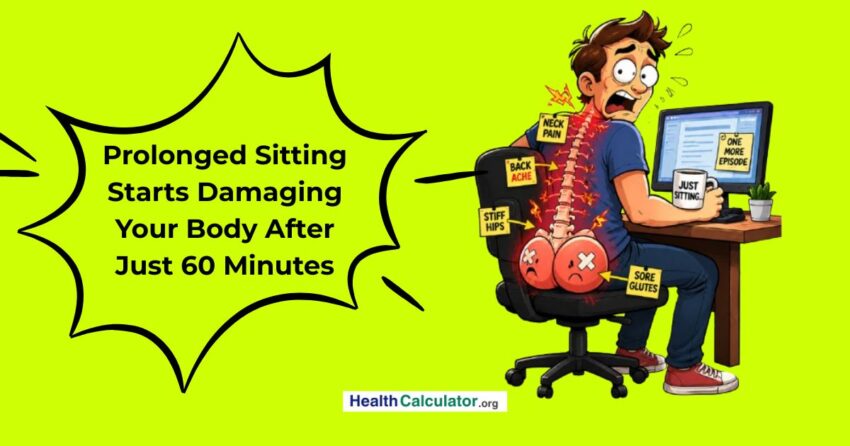
Most people sit for 8 to 10 hours a day. Work, commute, meals, screens and it adds up fast. And the problem isn’t just that sitting feels lazy. The problem is what’s quietly happening inside your body the entire time.
Prolonged sitting is not a minor inconvenience. Research now links it to heart disease, diabetes, chronic back pain, and even early death. And the damage starts sooner than most people expect.
Here’s what actually happens to your body the longer you stay seated.
The First 30 to 60 Minutes
In the first half hour, nothing feels wrong. But your body has already started adjusting.
Your leg muscles go quiet. Electrical activity in them drops significantly. Your calorie burn slows to almost nothing compared to when you’re standing or moving. Blood flow to your lower body starts to reduce.
After around 60 minutes, your body’s ability to process blood sugar starts to drop. The enzyme responsible for breaking down fat in your bloodstream which is lipoprotein lipase drops by about 90%. That’s not a typo. Ninety percent.
This is the point where prolonged sitting starts doing real damage. One hour is all it takes.
2 to 3 Hours In
By now your posture has likely shifted. You’re probably slouching without realizing it. The muscles in your lower back are under pressure they weren’t designed to handle for this long. The discs in your spine are compressed and not getting the movement they need to stay healthy.
Your hip flexors are shortening. Over time, this is one of the main reasons desk workers develop tight hips and lower back pain that never fully goes away.
Blood is beginning to pool in your legs. Your circulation has slowed enough that some people start to feel that heavy, stiff sensation in their feet and calves.
Your brain is also getting less blood flow. Focus tends to drop. You might feel a little foggy or tired even if you slept well.
4 to 6 Hours – Where It Gets Serious
This is where the side effects of prolonged sitting become more serious.
Your blood sugar is no longer being regulated efficiently. If you ate a meal in this window without moving, your body is struggling to manage the glucose spike. Over weeks and months of this pattern, insulin resistance can develop. That’s the precursor to type 2 diabetes.
Your risk of cardiovascular issues goes up. Sitting for long stretches reduces the flexibility of arteries and slows blood circulation enough to increase strain on your heart. Studies have found that people who sit for more than 6 hours a day have a significantly higher risk of heart disease compared to those who sit for less than 3 hours.
Your neck and shoulders are also under stress if you’re working at a screen. The head weighs around 5 kg. When it’s held forward toward a monitor, the effective weight on your cervical spine can multiply several times over.
What Happens Over Weeks and Months
A single long day of sitting won’t destroy your health. But the pattern matters.
If prolonged sitting is your daily routine, the effects stack up. Persistent lower back pain. Weakened glute and core muscles. Gradual weight gain from slowed metabolism. Poor sleep quality. Increased anxiety and lower mood. Reduced bone density over time.
One of the most overlooked dangers of sitting too long is deep vein thrombosis (DVT). This is when blood clots form in the deep veins of the legs due to poor circulation. It’s more commonly associated with long flights, but the same risk applies to anyone sitting still for hours at a stretch.
The World Health Organization lists physical inactivity as one of the leading risk factors for global mortality. Sedentary behavior which prolonged sitting is a major part of is directly tied to millions of preventable deaths each year.
“But I Exercise Every Day”
A lot of people assume their morning run or evening workout cancels out the sitting. It doesn’t work that way.
Research has shown that even people who meet the recommended weekly exercise targets still face elevated health risks if they spend the majority of their day seated. Exercise helps, but it doesn’t fully offset 8 hours of stillness. Movement needs to be spread throughout the day, not just concentrated into one session.
How to Reduce the Damage
The good news is you don’t need to stand all day or buy expensive equipment.
The most effective strategy is simply breaking up your sitting time. Getting up for even 2 to 5 minutes every 30 to 45 minutes has a measurable positive effect on blood sugar, circulation, and energy levels.
A few practical things that actually work –
Set a movement reminder. Your phone, smartwatch, or a basic timer works fine. Every 45 minutes, stand up and walk to another room, stretch, or do a few squats.
Walk during calls. Most phone calls don’t require you to sit. Walk around while you talk.
Stand after meals. A 10-minute walk after eating helps your body manage blood sugar much more effectively than sitting back down immediately.
Check your posture actively. Your screen should be roughly at eye level. Your feet flat on the floor. Your lower back supported. None of this eliminates the risks of prolonged sitting, but it reduces the physical strain significantly.
Stretch your hip flexors. A simple lunge stretch held for 30 seconds on each side, done a couple of times a day, can counteract the tightening that happens from long hours in a chair.
Know Your Numbers
Understanding your body’s health metrics helps you take sitting-related risks more seriously. If prolonged sitting is part of your daily life, it’s worth regularly checking things like your BMI, calorie needs, and ideal weight range.
You can use the BMI Calculator or the Daily Calorie Calculator on this site to get a clearer picture of where you stand and what your body actually needs.
The Bottom Line
Prolonged sitting is genuinely harmful. Not in a vague, theoretical way but in a measurable, documented way that starts within the first hour and compounds over time.
The dangers of sitting too long aren’t reserved for the elderly or the unfit. They apply to anyone whose day is mostly spent in a chair. And most of us, if we’re honest, fall into that category.
You don’t need a dramatic lifestyle overhaul. You just need to sit less and move more often throughout the day. Small, consistent breaks make a real difference. Your body was built to move. Give it the chance to do that.
Disclaimer: This article is for informational and educational purposes only and does not constitute medical advice. The information provided is based on general research and should not replace guidance from a qualified healthcare professional. If you have a medical condition or health concern related to prolonged sitting, posture, circulation, or related issues, please consult your doctor or a licensed physical therapist.