
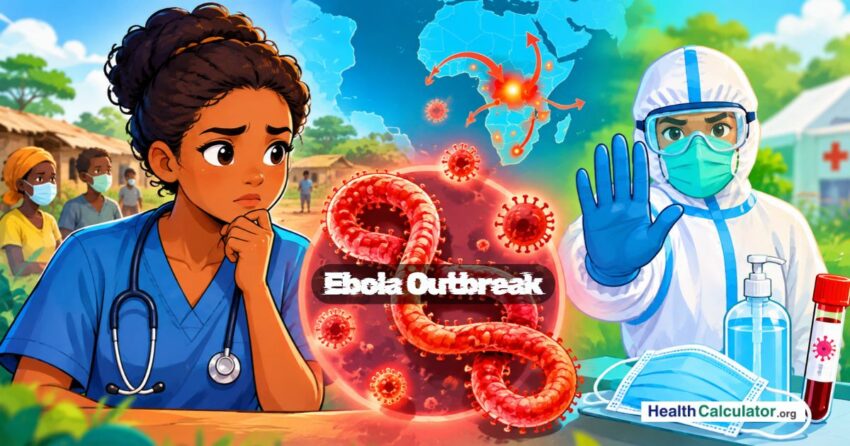
The Ebola outbreak of 2026 is not over. As of October 30 2026, the Democratic Republic of the Congo has reported more than 10,000 confirmed cases and nearly 5,000 deaths. This is the deadliest Ebola outbreak in the country’s history and the second largest ever recorded. The virus has crossed borders into Uganda, Kenya, and Nigeria. Cases have been medically evacuated to Switzerland and France. The World Health Organization continues to treat this as a public health emergency of international concern.
I have followed Ebola outbreaks for years. One thing I have learned is that the public memory of Ebola is short. Each time an outbreak ends, the world moves on. Then the virus returns. This article explains how Ebola spreads, what survival actually looks like, and what it takes to stop an outbreak. It is written to stay useful long after this particular emergency fades from the headlines.
Ebola Outbreak Status October 30 2026
The numbers change daily. The figures below are the most recent available from the WHO and the CDC as of October 30 2026.
The DRC remains the epicenter. The Ministry of Health reported 10,193 confirmed cases and 4,960 deaths as of October 27. The case fatality rate stands at 48.7 percent. The outbreak is active in eight provinces. Ituri Province carries the heaviest burden with more than 70 percent of all cases. Local teams are still reporting between 50 and 80 new confirmed cases each day. Roughly 80 percent of those new cases come from unknown transmission chains. That means contact tracers cannot link them to a known patient. This is a warning sign that the virus is spreading quietly in the community.
Kenya has reported 9 confirmed cases and 2 deaths in a single cluster. No new cases have been confirmed there since October 19. Nigeria reported its first case on October 20. The patient was a Ugandan born Swiss citizen who had recently traveled through Uganda. She was medically evacuated to a hospital in Geneva, Switzerland, on October 26.
The Bundibugyo virus is driving this outbreak. It is a rarer species of Ebola. There is no approved vaccine and no approved treatment for it. That single fact makes this outbreak different from the West African epidemic of 2014 to 2016.
How Ebola Spreads
Ebola does not spread through the air. You cannot catch it from someone who coughs or sneezes near you. The virus spreads through direct contact with the blood or body fluids of a person who is sick with Ebola or who has died from it.
That contact can happen in several ways. A family member might touch a sick relative without gloves. A health worker might treat a patient without full protective equipment. A mourner might touch the body of someone who died from Ebola during a funeral. Contaminated surfaces can also carry the virus. Bedding, clothing, and medical equipment can hold infectious fluids.
The virus also lives in animals. Fruit bats are the natural host of the Ebola virus. The virus can spill over into humans when people come into close contact with infected bats, chimpanzees, gorillas, monkeys, or forest antelope. This animal reservoir is the reason Ebola can never be fully eradicated.
One important fact for anyone worried about casual contact. People cannot spread Ebola before they show symptoms. They become infectious once symptoms begin and remain infectious as long as their blood contains the virus.
Symptoms and Survival
Ebola symptoms usually appear between 2 and 21 days after exposure. The first signs are often vague. Fever, fatigue, muscle pain, headache, and sore throat appear first. Vomiting, diarrhea, abdominal pain, and a rash can follow. Bleeding is less common than most people assume. It happens in severe cases but it is not the defining symptom.
The World Health Organization Ebola fact sheet puts the average Ebola case fatality rate at around 50 percent. Across past outbreaks it has ranged from 25 to 90 percent. Those numbers sound terrifying. But they hide an important detail. Survival depends heavily on how quickly a patient receives care.
Early intensive supportive care saves lives. Rehydration is the single most important intervention. Patients who receive fluids early, along with treatment for fever, vomiting, and diarrhea, have much better outcomes. In past Bundibugyo outbreaks, the fatality rate was between 25 and 40 percent. With good supportive care, that number can drop further. The lesson is simple. Seeking care early makes a measurable difference.
What Stopping an Outbreak Actually Looks Like
Stopping Ebola is not a single action. It is a package of measures that must work together.
Contact tracing is the backbone. Teams interview every confirmed patient. They find everyone that person had close contact with while they were infectious. Those contacts are monitored for 21 days. If they develop symptoms, they are isolated immediately. This breaks the chain of transmission.
Isolation and treatment come next. Suspected and confirmed patients are treated in specialized centers. This keeps them away from family members and others who could become infected.
Safe and dignified burials are essential. Funeral rituals that involve touching the body of someone who died from Ebola can spread the virus. Response teams work with communities to ensure burials are safe while respecting cultural and religious traditions.
Infection prevention and control protects health workers. Hand hygiene, protective equipment, safe waste disposal, and chlorinated water points are standard requirements in treatment facilities.
Vaccination plays a role where an approved vaccine exists. The Ervebo vaccine is approved for the Zaire Ebola virus. It is used in a strategy called ring vaccination. Health teams vaccinate the contacts of confirmed patients and the contacts of those contacts. This creates a protective ring around each case. Ring vaccination reduced deaths by roughly 65 percent in modeling studies of the current Bundibugyo outbreak. But Ervebo is not approved for Bundibugyo. A new trial called the Tumaini trial began in October 2026 to test vaccine candidates against this strain.
Community trust is the final and most fragile piece. In the DRC, health workers have been attacked. A nurse was killed in Tshopo province in late October while responding to an Ebola alert. Misinformation and fear are fueling violence. Without community cooperation, every other measure fails.
Why Ebola Keeps Coming Back
Ebola was first identified in 1976. Two outbreaks happened almost simultaneously. One was in what is now South Sudan. The other was in a village near the Ebola River in the Democratic Republic of the Congo. Since then the DRC alone has experienced 17 outbreaks.
The virus keeps returning because it never leaves. It circulates quietly in fruit bats. Every so often, a spillover event moves the virus from an animal into a human. Deforestation, hunting, and the wildlife trade increase the chances of that happening. Once the virus enters a human population, it spreads through close contact. Outbreaks end when the human transmission chain is broken. The virus itself remains in the forest, waiting for the next opportunity.
This is why the question of eradication is misleading. Ebola cannot be eradicated like smallpox. Smallpox lived only in humans. When human transmission stopped, the virus was gone. Ebola has an animal reservoir. As long as that reservoir exists, the risk of future outbreaks remains. The goal is not eradication. The goal is rapid detection and fast containment.
What You Can Do
Most people reading this are not in an outbreak zone. The personal risk for anyone outside the affected regions is very low. The CDC and the European Centre for Disease Prevention and Control both assess the risk to the general public in Europe and North America as low.
If you travel to an affected area, follow basic precautions. Avoid contact with wild animals and animal carcasses. Do not touch anyone who appears sick. Avoid funerals or burial ceremonies where the body may be touched. Wash your hands frequently. If you develop a fever or other symptoms within 21 days of returning from an outbreak region, seek medical care immediately and tell the doctor where you traveled.
General health habits support your body’s overall resilience, though no supplement or lifestyle habit prevents Ebola. If you want to read more about everyday immune health, see our guide on ways to boost your immune system naturally. The only proven protections against Ebola are avoiding contact with infected people and their body fluids, and vaccination where an approved vaccine exists.
In Short
The 2026 Ebola outbreak is a serious and ongoing emergency. It is driven by a virus strain with no approved vaccine. It is spreading in regions with limited healthcare infrastructure and deep community distrust. The response depends on contact tracing, safe burials, supportive care, and eventually a vaccine that works against Bundibugyo.
Ebola is not eradicated. It will return again. The best defense is not fear. It is preparation. Fast detection, early care, and community trust are what stop an outbreak. That lesson is true today and it will be true for the next one.
Related reading. For more on infectious disease symptoms and treatment, see our guide to whooping cough symptoms and treatment and our explainer on Shigella infection and diarrheal disease.
Disclaimer: This article is for general information only. It is not medical advice. Ebola is a serious disease. If you have concerns about your health or possible exposure, contact a healthcare professional or your local health authority. Outbreak numbers and official guidance change often. Check the World Health Organization or your national health agency for the latest information.